

PCB manufacturers: Differences between multi-layer circuit boards and dual panel boards
What is a double-sided circuit board
Both sides of a double-sided circuit board have wiring, but double-sided wires need to be used, and there must be appropriate circuit connections between the two sides. This type of "bridge" between circuits is called a conductive hole. A through-hole is a small metal hole on a circuit board that can be connected to double-sided wires. Due to the fact that the area of the double-sided panel is twice as large as that of the single panel, the double-sided panel solves the difficulty of staggered wiring in the single panel and is more suitable for use in circuits that are more cluttered than the single panel.
What is a multi-layer circuit board
In order to increase the area that can be wired, multi-layer boards use more single or double-sided wiring boards. It is a printed circuit board that uses one double-sided inner layer, two single-sided outer layers, or two double-sided inner layers and two single-sided outer layers. The printed circuit board is formed by alternating the positioning system and insulation bonding materials, and the conductive graphics are interconnected according to the planning requirements. It is also known as a "multi-layer printed circuit board". The number of layers on a board does not necessarily mean there are several independent wiring layers. In special cases, empty layers are used to control the board thickness. Usually, the number of layers is even, and most motherboards, including the outer two layers, have a structure of 4 to 8 layers. Due to the tight integration of each layer in the PCB, it is generally not easy to see the actual number, but if you carefully observe the motherboard, you can still tell.
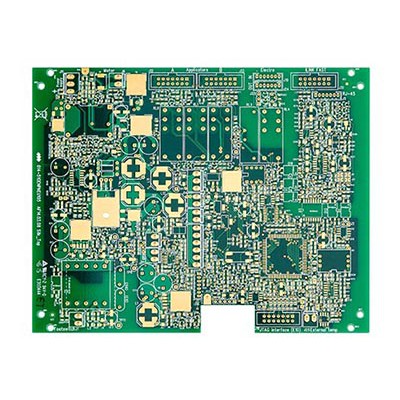
The difference between multi-layer boards and double-sided boards is the addition of an internal power layer (maintaining the internal electrical layer) and a ground layer. The power and ground networks are mainly wired on the power layer, while the wiring of multi-layer boards is mainly based on the top and bottom layers, supplemented by the middle wiring layer. The planning method of multi-layer boards is fundamentally the same as that of double-sided boards, with the key being how to optimize the wiring of the internal electrical layer to make the wiring of the circuit board more reasonable and have better electromagnetic compatibility. The difference between multi-layer circuit boards and double-sided boards is that the pressure plate material of double-sided boards only includes P sheets and Cu foils; The pressure plate material for multi-layer boards includes both P sheets and the two Cu foils on the outer layer, as well as the inner layer board between the P sheets. The production of multi-layer boards involves the production of inner layer boards. The production of inner panels is generally similar to that of outer panels.
Article source: PCB manufacturerhttp://www.yonghongpcb.com/
-
09-09
Schematic diagram of Jiangmen single and double-sided circuit board
1. There are now various specialized PCB drawing software, such as Protel, which can draw multi-layer (including double-sided) circuit board diagrams. The layers are aligned in orientation and have vi
-
09-09
Schematic diagram of Jiangmen single and double-sided circuit board
1. There are now various specialized PCB drawing software, such as Protel, which can draw multi-layer (including double-sided) circuit board diagrams. The layers are aligned in orientation and have vi
-
09-09
Schematic diagram of Jiangmen single and double-sided circuit board
1. There are now various specialized PCB drawing software, such as Protel, which can draw multi-layer (including double-sided) circuit board diagrams. The layers are aligned in orientation and have vi
-
04-27
What is the structure of blind buried hole circuit board?
blind and buried viascircuit boardIt has the ability to freely bend, fold, and roll, and can move and stretch freely in three-dimensional space; Good heat dissipation performance and high precision; T